
Travel story
Giddo in Warwick and Birmingham
A castle garden, a knight's gilded tomb, a canal city that outdoes Venice on paper, and one strange gold afternoon over Birmingham when a solar eclipse caught an entire roof terrace off guard.
Where to stay in Warwick
See the hotels and apartments available on Booking.com · This is an affiliate link with our partner. Europe by Giddo may earn a commission from a purchase made through it, at no extra cost to you.
Warwick and Birmingham sit about ten miles apart on the map and feel like different centuries. I gave the first a slow morning and the second an evening — not really enough time for either, and I would go back to both without hesitation.
Our partner
Travel insurance · 5% off for our readers
Get a quoteThis is not a full account of the two days. It is what actually stayed with me afterwards: a knight lying gilded on his own tomb in a chapel that feels almost too small for him, a church tower with the whole roofline of a small English town laid out underneath it, a canal basin doing a very different job today than the one it was dug for, and one strange gold afternoon over a city centre when the sun went half out and everyone on the roof terrace stopped talking at once.
The castle from the garden side
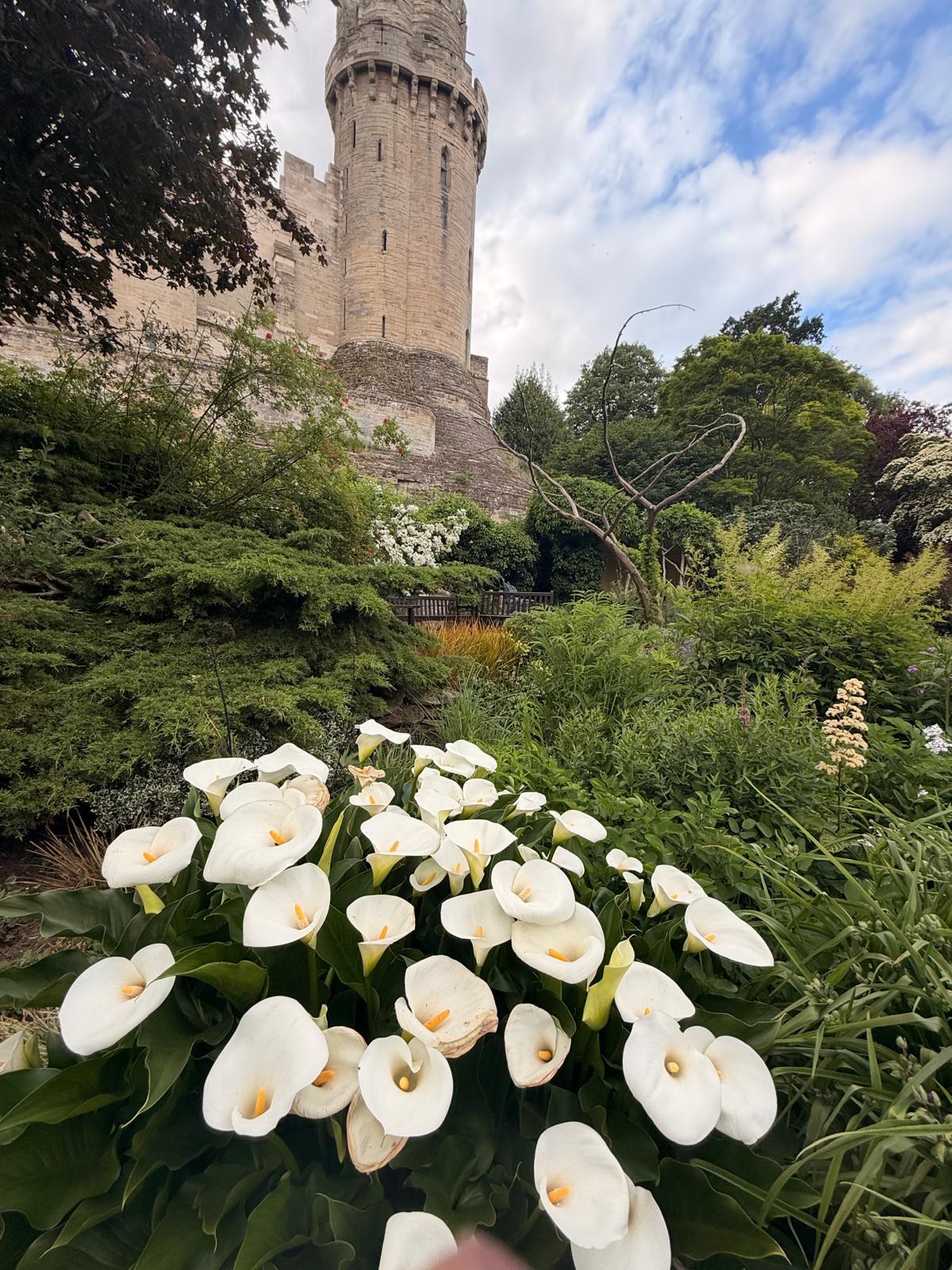
Warwick Castle is the first thing you see arriving in the town, and I did not go in through the ticket gates. The grounds are enough on their own: a rose garden gone slightly wild at the edges, a conservatory full of lilies with the glass throwing a soft green light over everything inside it, and a bench set at exactly the angle you would choose yourself if nobody had put one there already.
Caesar's Tower and Guy's Tower stand up over the river behind all of it, stone the colour of a wet afternoon, and from a window slit halfway up one of them you can see straight down to the water without anyone having built the view on purpose — it is just where the wall happens to be thin. Somewhere in the garden a stone cat sits on a plinth watching the whole thing with an expression that suggests it has seen enough tourists to last several centuries, which, being a stone cat, it probably has.
Up the tower at St Mary's
The Collegiate Church of St Mary is a short walk from the castle and, unusually for an English parish church, it lets you climb it. The stair is narrow and takes longer than it looks like it should, and it comes out onto a platform with the whole town laid out below: red roofs, the line of the Avon, and the castle's own towers seen from a height that makes them look smaller and somehow more serious.
Inside, the nave is tall and plain in the way these churches usually are, with an organ at one end that I would have liked to hear properly rather than just look at.
The reason to come, though, is the Beauchamp Chapel, built onto the side of the church in the fifteenth century for Richard Beauchamp, Earl of Warwick. His tomb sits in the middle of it: a gilded effigy lying flat with its hands raised, under a vaulted ceiling far more elaborate than the plain church around it prepares you for. It is generally counted among the finest chantry chapels in England, and standing in it, gold catching the light from somewhere above, that is not a hard claim to believe.
A town still shaped like itself
Between the castle and the church, Warwick is the kind of town where you can still see the shape of the old street plan even though a fire in 1694 took a large part of it and left a lot of what stands now in Georgian brick rather than the original timber. The Eastgate still has traffic running underneath it, which always surprises me about old town gates that are still doing their original job rather than standing in a museum somewhere.
Bunting was up along the High Street the day I was there, for no occasion I could identify, which felt about right. Down by the river the water meadows are quiet, a lily pond sits still enough to double the sky, and the Avon just keeps going, past the castle, on towards Stratford and beyond.
Ten miles on, into Birmingham
Birmingham does not try to be Warwick and does not need to. It is England's second city, built on trade and manufacture, and it still wears that history openly rather than tidying it away: the canal network that once moved raw materials and finished goods through the city is still there, and Birmingham is often said, with a completely straight face, to have more miles of canal running through it than Venice.
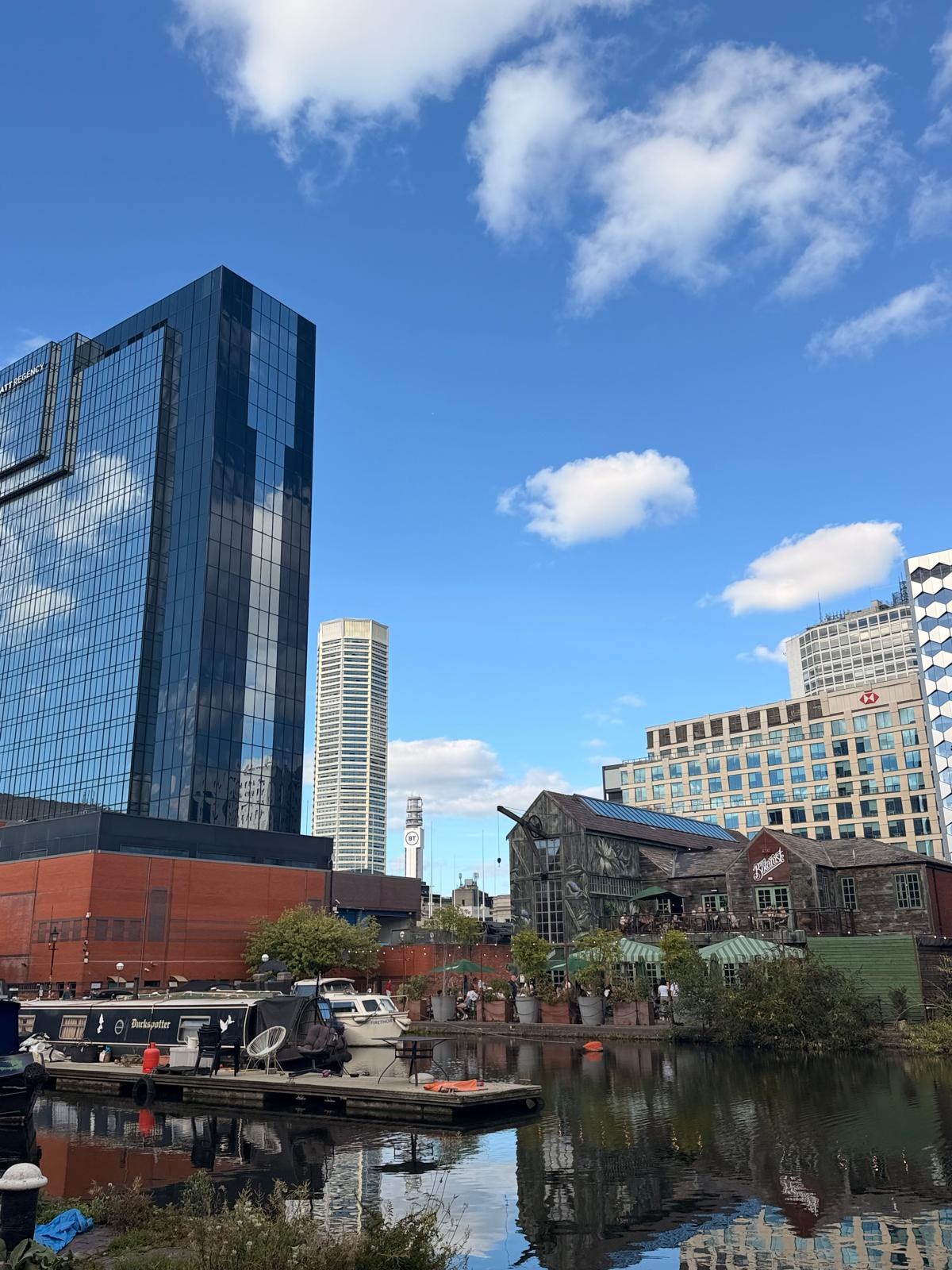
They are put to a different use now. At the basin in the centre, towpaths that used to serve warehouses now run past bars and restaurants, and narrowboats sit moored along the water with nowhere particular to be. It is a strange, pleasant contradiction: genuinely industrial infrastructure that has become one of the most relaxed places in the city centre to spend an evening.
Above the water, the Great Western Arcade holds its glass roof and its Victorian shopfronts from 1876, a few streets from towers of glass and steel that are barely a generation old. The old city and the new one are standing on top of each other rather than replacing one another, which is more or less how Birmingham seems to like it.
A gold afternoon over the rooftops
I was on a roof terrace with a plate of food I have already forgotten, watching the sunset build over the towers the way it does most evenings in a city this size, when the light started doing something it should not have been doing at that hour.
A partial solar eclipse had crept up on the afternoon, and for a few minutes the sky over Birmingham went the colour of very old brass — not dark, exactly, just wrong, in a way that made everyone around me stop mid-sentence and look up at the same time without being told to. Somebody had brought the right glasses. Most of us just squinted at the shadows instead, which is apparently how everyone actually experiences a solar eclipse, expert advice notwithstanding.
It lasted a few minutes, and then the ordinary evening light came back, the terrace went back to talking, and the towers of England's second city went back to being exactly as unremarkable and enormous as they were before the sun did something strange over the top of them.